Comets and Meteors
(this only has Comet's information on here right now but give me some time and I will edit it with the meteor information.)
Comets are one of the most rare objects in the night sky. Comet comes from the Greek word that means 'hair of the head'. The name comes from Aristotle who saw comets as 'stars with hair'. They have beautiful tails and soar though the sky coming from outer realms of the solar system. But when you see them in the sky you wouldn't think about the fact that they are just little worlds that scientists sometimes call a planetesimal. They are made up of 70 to 80 percent of gas and water. The leftover 20 to 30 percent metal and rocky material in tiny chucks roughly the size of dust. The outside layer of it is made of ice.
They were originally part of the nebula that formed when a start exploded into a supernova. But the balls didn't form into planets when he rest of the material in our nebula merged together to form the rest of the planets in our system about 4.5 billion years ago.
The Kuiper Belt and the Oort Cloud are the two places that comets come from. These two places are at the very edge of the solar system. In these places, you can see millions of comets zooming around in every direction. They rotate around the sun on their own path just like the rest of the planets on the inside of the system does.
Now you may be wondering why they would leave these places, but if you are picturing millions of them in every direction, it shouldn't be too hard to guess. Sometimes two of them will come a bit too close or even crash into one another. This will make them change directions and sometimes their new path brings them from the outer to the inner solar system. There is a chance that there are comets going around other stars as well, but they are too small for our telescopes to see yet.
This is when the magic happens that people come to associate with comets. While they were on the outer they had no shine and was just balls of ice and dust among others just like them. Now as they enter the inner system they begin to act just like ice outside of a freezer. They begin to melt and form the shape we have come to know. There are three parts to each comet the tail, head and halo. The tail actually has two parts to it one is the ion tail and the other is the dust tail. A halo is the material that surrounds the nucleus. The head is surrounded by hydrogen gas which is the cloud-like mass we see in the front of the comet.
Here is a wonderful fact that is kind of cool. A lot of people think that the tail is always following behind a comet. However, this is not always a fact. They can have a tail both behind and in front of them. The deciding factor is based solely on the sun. Now here is the interesting part. The sun's heat along with radiation produce a wind that is better known as the Solar Wind. As the comet gets closer to the sun, it melts. The dust and gas that melts off get blown away from the sun by the sun's winds. So if it is moving towards the sun then the tail will be behind the comet. When it is traveling away from the sun then the tail would be in front of the comet.
Just like a snowman when the weather starts to warm, the comets melt making them not live very long once they enter the warmer part of the solar system. Even though it's the most wonderful part of their lives, it eventually will kill them. After about 800 trips near the Sun, comets can become just balls of rocks. It don't take one year but several thousand years before they melt down to a tiny bit of ice and dust, but not nearly enough to leave a tail at all anymore. Some of them even melt away to nothing. A good bit of the asteroids near Earth are old dead comets. We will get more into that in lesson three.
Most of the comets that come near Earth, only come by once then shoot off into outer space beyond the solar system for thousands of years before they come back. A few of them have smaller orbits causing them to stay mostly in the solar system. The paths are oval shaped so the time can take can be seven or millions of years before they finish one rotation. Their orbits are the main reason that we see some once every few years and others are only spotted in thousands of years making them really once in a life time chances to see.
The time it takes comets to finish their orbits, make them one of two kinds of comets. One is short term or periodic comets, which have orbital periods of less then 200 years. Long term comets have a orbital period of over 200 years. Roughly ten new comets are discovered each year, most of which can't be seen without the help of a telescope.
When a comet gets close enough to the Earth, some of the smaller rocks get sucked into our gravity. These then fall down to Earth and we call these Meteors, we will learn more about these next lesson. Some comets end up hitting the sun or other planets, or come close enough to Jupiter to be affected by its gravity. These get shoot out of the solar system like rocks in a slingshot.
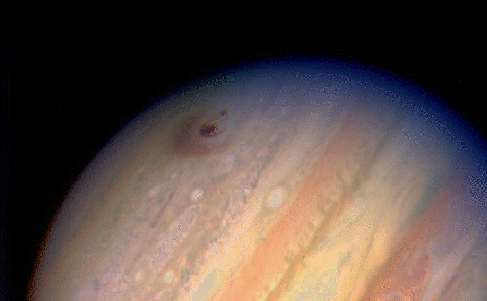
The comets get their names usually from the person who discovered them. March of 1993 Eugene M. and Carolyn Shoemaker and David Levy were watching the skies when they spotted a comet. The comet became known as the Shoemaker-Levy 9 comet after the astronomers that discovered it. This comet however, broke apart and collided with Jupiter in July 1994. This event gave astronomers a unique chance to see what happens when this kind of collision happens. The fragments struck Jupiter at such a great speed that the scars were visible for months afterword.
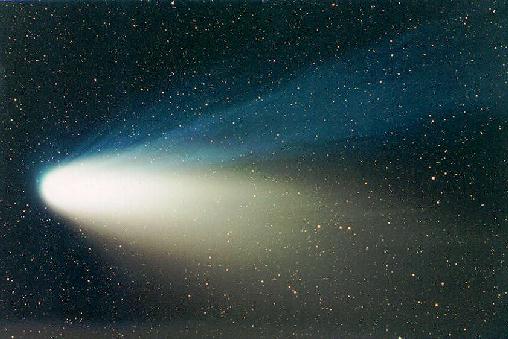
A guy in southern New Mexico named Alan Hale and Thomas Bopp in Arizona discovered a new comet at roughly the same time on July 22, 1995. The comet became known as the Hale-Bopp comet for both the men. It was the brightest comet discovered for about 400 years. It looks so bright, you can see it without a telescope. It travels ten times farther from the Sun then Neptune at it's farthest point in orbit.
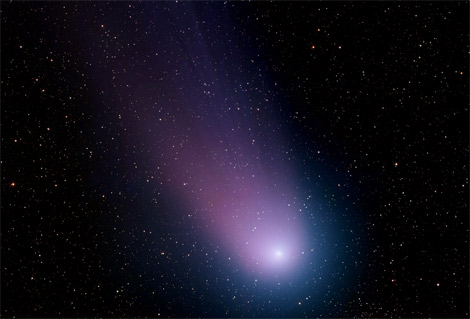
An English Astronomer named Edmond Halley is the one who first determined what a comet's period of orbit was and it became known as Halley's Comet. This is one of the comets that most have heard about. It can be seen with the naked eye from Earth every 75 to 76 years but has gone 74 and 79 years between visits. Records of this comet goes back thousands of years noted by European, Chinese and Babylonian star gazers. It last graced us with an appearance in 1986 so it will return sometime around 2061.
